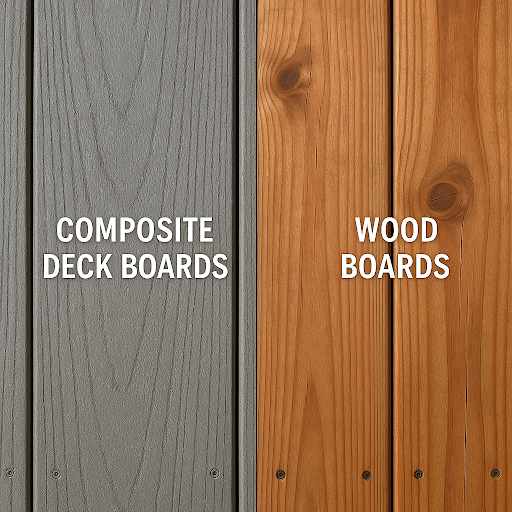
Which composite decking should you buy? Grades, colours and price explained

Updated: Nov 6
Composite decking comes in grades, and the grade decides more than the price: what the board is made of, how it handles sun and water, the colours and widths you can pick, and the warranty. We install three Deckorators lines, Venture, Summit and Voyage, a good, better and best. For most decks we lean to Summit and Voyage.
What is composite decking made of?
"Composite decking" is a category, not a product. On a quote it can mean one of three kinds of board:
Capped composite: a dense core with wood fibre in it, wrapped in a protective cap. Deckorators Venture is one.
Mineral-based: one material all the way through, with no wood in it. Deckorators' Surestone boards, Summit and Voyage, are made this way.
PVC: all plastic. It isn't our go-to board, but it isn't ruled out.
They're made differently, so they behave differently in the sun and the wet. That's why the first question to ask about any quote is: which board, exactly? Which maker, which line, which colour?
What are the grades of composite decking?
Deckorators makes five lines, and we install three of them, a good, better and best. Here's how they compare.
Venture: good
Capped composite: a dense core with a scratch-resistant cap wrapped on three sides
A natural wood-grain finish
Colours: Saltwater, Sandbar and Shoreline
5.5-inch boards, 12, 16 and 20 feet long
25-year structural and stain and fade warranty
95% recycled content, made in the USA
Summit: better
Surestone, mineral-based, no wood
A low-gloss finish that stays cooler underfoot, and won't splinter, sag, chalk or crack
Colours: Glacier, Boulder and Cliffside
5.5-inch boards up to 20 feet long
25-year structural and 25-year stain and fade warranty
Costs more than Venture
Voyage: best
Surestone, mineral-based, no wood, with a comfortable, lightweight feel underfoot
34% greater surface traction than other leading brands of composite decking, the maker says
Colours: Sierra, Tundra, Costa, Mesa, Khaya and Sedona
3.5, 5.5 and 7.25-inch planks
50-year structural, 25-year stain and fade and 25-year removal and replacement warranty (water and ground contact)
The highest price of the three
Warranty terms are from Deckorators' 2026 sell sheets.

Which grade do we recommend?
There's no perfect deck board. A dark board in full sun, a shaded deck that stays damp, a pool edge: each one changes the right answer. Our picks:
Full sun: Summit or Voyage, in a lighter colour.
Pool, hot tub or dock: Voyage first.
Shade and damp: Summit or Voyage.
Budget first: Venture.
We lean to Summit and Voyage for the strength of a composite with no organic material in it. Mike says it's "not common" for anyone to come back wishing they'd gone with the lesser board. It's the other way round that he hears: when people pick the board they didn't really want for budget reasons, which are fair, "it's pretty common to hear" that they "wish we would have just spent that little bit extra."

How do you choose a colour?
Start with the sun. "The darker is gonna get slightly warmer than the lighter one," Mike says, and boards get a little more uncomfortable in direct sun as you move into the darker colours, like Khaya. That doesn't rule them out. It means we need to know which way the deck faces and how you'll use it before we pick.
Then think in pairs. A second colour as a border or an inlay frames the deck. Mike's two Voyage greys "work great as accent colors" for each other. Voyage, with six colours, gives you the most to work with.
Pick from real boards, not a screen. We bring real board and colour samples to the site and walk you through the pros and cons of each.

Do board width and texture matter?
Width changes the look more than most people expect. Venture and Summit come in a 5.5-inch board; Voyage comes in 3.5, 5.5 and 7.25 inches, so you can go wide or mix widths for a varied-plank look.
Texture is about grip as much as looks. Each line has its own surface, and if slipping is your main worry, tell us. "We're gonna show you the differences, the different tractions on each board," Mike says. Our post on whether composite decking is slippery goes deeper.
What drives the price of composite decking?
The grade is the first step up: Summit costs more than Venture, and Voyage is the highest price of the three.
Then comes what's under the boards. We match the frame to the board: pressure-treated, today's fast-growth lumber, under Venture; Fortress steel worth a look under Summit, and definitely under Voyage. In Mike's words, under Summit and Voyage "the structure that is underneath them honestly is just as important if not more important" than the board.
After that, the railing, stairs, lighting and your site do the rest. Our guide to what determines the cost of composite decking goes through each one.
What mistakes should you avoid?
Buying a quote that just says "composite." Ask which maker, which line and which colour.
Picking from a photo. See and hold the real boards.
A dark colour in full sun without knowing how warm it will get.
A premium board on a frame that isn't matched to it. Match the frame to the board.
Settling on the board you didn't want to save a little, then wishing you hadn't.
Talk to us about your deck, or call (705) 300-2903.
Want every board, railing and lighting option in one place? Download our 2026 Buyer's Guide.
What do people ask us?
What are the grades of composite decking?
We install three Deckorators lines, a good, better and best: Venture, a capped composite, then Summit and Voyage, both mineral-based Surestone boards with no wood in them.
Which composite decking is best?
There's no perfect deck board. In full sun we lean to Summit or Voyage in a lighter colour; around a pool, hot tub or dock, Voyage first; and where budget comes first, Venture.
Does composite decking get hot?
Not all of it. Darker colours get slightly warmer than lighter ones in direct sun, so for full sun we'd pick Summit or Voyage in a lighter colour. Deckorators says Summit stays cooler underfoot.
What warranty comes with composite decking?
It depends on the line. Deckorators' 2026 sell sheets give Venture and Summit a 25-year structural and 25-year stain and fade warranty, and Voyage a 50-year structural, 25-year stain and fade and 25-year removal and replacement warranty.
Do you install PVC decking?
PVC isn't our go-to board, but it isn't ruled out. We lean to the mineral-based boards: the strength of a composite with no organic material in it.
Keep reading
Mike · Simcoe Decks · Updated 2026-11-06
Simcoe Decks · 92 Caplan Ave, Barrie, ON · (705) 300-2903 · info@simcoedecks.ca